Desire doesn’t go away, but she does cover herself up.
She has tact. She doesn’t force things. Desire doesn’t do force. So: when her invitation to your life is declined, she doesn’t call twice or three times — she takes you at your word, that this isn’t the time.
“When you’re ready,” she says. But how does she know you’re ready?
She’s on your team. Always. She wants to be met. But having heard your No, she does not come in the same guise. Instead, she sends her guardian forms: apathy, disbelief, fear, doubt.
The only way forward is to meet them. Are you willing? They’re here to destroy you. Yes, that’s clear. Do you trust what will survive them?
Don’t run from them. Let them get loud. Let them sink their claws into you. Hear the voices: that you’re wrong, that you’re bad, that you can’t have what you want, that you don’t want it anyway. Let yourself bargain and speak words you know aren’t true, that you’ll make another path work for you.
Just keep listening…
Keep listening until you can hear her voice again.
Keep listening until you have acquainted yourself with every corner of your fear, until you can feel, even in the deepest layers of your apathy, the buzz that tells you there is still something you are wanting.
Listen, listen, until this buzz resolves into a call. Listen until you can hear it coming from deep within you. Listen, as Desire comes forward, until you can hear the sweetness of her voice tell you what you must do. The clearest way. The only way.
For what must you walk through the fire?
For what must you refuse to turn your head?
For what must you give up the comfort of your apathy, your disbelief, your fear, your doubt, these things that ask nothing of you?
Printed in Spring 2026 in Communities Magazine #210. Reproduced here with permission.
By Daway Chou-Ren
The Enticing Model
When I sat down for dinner with my friend Nathan, his idea for how communities could rent and eventually buy homes, keeping money circulating within the group, lit me up. Communities generate relational, creative, and cultural value, yet—at least for renting communities—most of their finances flow to an outside landlord.
At the community where Nathan and I met and became good friends, former residents had transformed their very large, barren basement, using their own money, into a vibrant gathering and event space with dozens of events a month. It became a beloved third space. In swooped the landlord. Seeing the property’s increased value, he raised the community’s rent.
Nathan wanted to remove the landlord from his next community, and he had found an interesting opening. Where we live there are all these oversized homes. He came across an unwieldy 18-bedroom house. Who better to rent such a place than a community? Who better to eventually buy it? He negotiated a favorable two-year lease with first rights to purchase after that. I found the possible future compelling: what if we could live together, build real bonds, and let our commitment grow slowly? We could rent first, and co-own later. No cold feet from jumping too fast into a group purchase.
Nathan would be the master tenant. He was taking on real risk and leadership: signing a lease without knowing whether the house would fill, negotiating terms and renovations with the landlord, and carrying a compelling vision for a community that aimed to make meaningful cultural change in our town. His vision of crafting culture and sharing it is what drew all of us together. He planned to make the top floor a paid workshop space, a place where the relational work we practiced and refined at home could be shared more widely. For all of this risk, vision, and labor, he planned to charge the community rent above his own costs and take a share of the workshop revenue.
I had some concerns. Is community something to profit from? But I felt it was better for communities to exist, with founders compensated for the work of making them possible, than to not exist at all because no one can afford to take on that labor for free.
Can profit be part of communities in ways that strengthen and help spread them, rather than something that destroys them? I’m writing from inside this experiment, as we run into painful, unresolved tensions. And I write as someone who lived with Nathan in a previous community with a similar landlord–master tenant–subtenant structure, one that ended in lawsuits, deteriorated relationships, and a messy dissolution. We both knew things had to be different. This piece is about how hard that shift has proven to be.
Secrecy
If money is the root of all evil, secrecy is the shadow that feeds it.
At our former community, we also had a master tenant. He worked tirelessly to run the gathering space. He was the reason it continued to exist, and all of us residents benefited from it. In private, he charged the community surplus rent to create a buffer fund. When I eventually learned of this, I thought it was wise: someone has to cover the shortfall when a housemate leaves so there’s no time pressure to fill their space. He also took a free room. Given how much he did for the gathering and event space, I personally had no issues with this level of compensation after I found out.
But he didn’t tell anyone. When these secrets came out, residents were furious. Without transparency, there was no chance for subtenants to consent to their higher rent. With this sense that everyone was just taking for themselves, the relationships between the residents, the master tenant, and the landlord fell apart.
When trust breaks, people often justify their own retaliatory behavior. A legally minded resident stopped paying rent and eventually sued the landlord; she was paid tens of thousands to leave. The landlord finally decided he was done with the headache of dealing with a 20-person community. He bought everyone else out, ended the community’s lease, and closed the beloved public gathering space.
The Pain of Talking about Money
So when Nathan told me he intended to take a monthly profit from this new community, my alarm bells went off. He had internalized the lesson to be upfront that he was charging surplus rent, but as he talked, he still wasn’t telling me how much. My partner and I told him we wouldn’t move in until he agreed to share the actual numbers with the house because any vagueness would create the shadow for rumor to take root. I did not want to be a part of a house with easy places for resentment to build.
Nathan understood. He also froze. He named aloud that he didn’t feel safe revealing the details to everyone. Money is a ripe target for projection. Being at the center of profit invites other people to land their fears and stories on you.
Eventually he agreed. He called the community and held an open meeting to walk us through the books. The numbers were only partially there: the house wasn’t full yet and the event space wasn’t really running, but the projected surplus was thousands per month.
Months later, with all rooms filled, several housemates asked for a second transparency meeting. Nathan presented the same projections—still no updated numbers. People were upset there was no clarity. Nathan was not inclined to provide more details. People shouted. Eventually, everyone let the matter drop, but the consequences of that opaqueness still linger.
I long for the day when communitarian can be a proudly worn job title and not just a passion hobby. When people can profit from the hard work of leading a group and taking a risk in starting something, and have that be acceptable. When communities have healed enough of their wounds around money that we can talk about it freely.
For now, the opaqueness around the level of profit in our home creates a steep power imbalance. It signals “I don’t trust you” and crushes collaboration before it can form.
I recently facilitated an all-house meeting where we all gave Nathan our feedback on this. Everyone there voiced a concern about the financial and power structures of our community. One housemate said to Nathan bluntly: “You’re a landlord.” We, it seems, have gone just about full circle. For most of us, the profit Nathan is taking is not a problem, but the opaqueness and magnitude of it is.
The Consequences
It’s become clear that the economics we’re operating under are those of a business, not a co-op or community. That might even be workable except Nathan’s not the only one creating value, not by a long shot, so the equation is out of balance. Something fundamental is off. We’re a house full of cultural creatives—artists, facilitators, technologists, and healers—and yet, we’re not creating together. People are launching individual events and projects aligned with our community’s mission, but not communal ones.
Systems balance themselves out. Our house could come back into balance if he split the profit with the others doing the heavy lifting of bringing his vision into the world. But he won’t. So the system balances itself in another way: the communal initiative and value others create begins to recede.
The shape of our community—collapsing to a single point with Nathan at the top—isn’t working, not just for us, but also for him. “It’s lonely at the top,” the saying goes. It’s also exhausting. Nathan can’t step back or falter. The structure doesn’t let him. If he isn’t holding the whole community all the time, how does he justify his income?
There’s another consequence to failing to distribute ownership. It’s not just that those unwoven into the community stop contributing. Worse, when conflict comes, they might not hesitate to tear it apart.
Recently, two housemates who had been in a long conflict with Nathan moved out. Their complaints ranged from critiques about the wisdom of his decisions, to his opaqueness about the financials, to feeling like he was shutting their voices down and not letting them contribute. Their integrated gifts hardened into resentment and then into open hostility. They were so outwardly resentful and on edge in their final days that our housemates on their floor temporarily moved out until they left.
The intensity of this fracture, and I think the fracture itself, existed partly because our financial model never created a shared sense of “we’re building this together.” Just as disenfranchised citizens won’t hesitate to disrupt social contracts; disenfranchised community members will often try to burn down the house.
A Way Forward
I still haven’t ruled out the wisdom of experimenting with a for-profit community. I’d like founders to be compensated for their risk-taking, for bringing something into the world that wouldn’t otherwise exist. But I’ve realized that any for-profit community needs much more than financial transparency. Maybe the founder’s profit taken needs to taper off as others step up and the founder holds less and less. But if profit remains, any healthy community needs a clear path for distributing its sense of ownership, and in this case, that means a path for distributing profit over time.
Not necessarily in equal proportions. Even the egalitarian income-sharing communities that I’ve visited still elect certain members to hold greater responsibility. In our community, some contribute more, some contribute less, and some are here just to soak it in and receive. I think distributed ownership can reflect that
What I do know is that those who build community—who set the vision, who fine-tune the systems, who mediate conflicts so people can continue to live together, who bring the je ne sais quoi that others find enlivening—are creating something valuable. My first exposure to this was when I moved to the Bay Area for a summer internship. I saw an “intentional community” ad on Craigslist with no clue what I was walking into and found a house bursting with connection, love, and aliveness. I remember thinking “Adult life can be likethis?” My dread about graduating the next year evaporated. That internship has faded from memory; that summer in community hasn’t. It changed me and taught me more about myself than any job I’ve had since.
The summer before, I paid $5000 to join a Mandarin immersion program in Beijing. Looking back, would I have paid that or more for the relational immersion I received in that house? Absolutely.
There is a vision here: of a community that brings in money for the cultural and relational experiences it offers to guests and non-core residents who sense a different way of living is possible. Our community, through the workshops we lead, has already helped many people grow into more love, aliveness, and well-being. And there are many other ways a place like this can generate value. There is a path for both founders and core stewards to be compensated, for them all to collaborate in growing the value that the community creates.
I don’t know if ourcommunity can shift to a model where the monetary value flows back in some proportion to those who do the most to steward our culture, where releasing financial control actually opens the door to more inventive creation. Systems are hard to change. Money is even harder. It’s difficult to talk about, harder still to loosen one’s grip on. And maybe introducing profit just inevitably corrupts what makes a community wonderful, no matter how good your system is for distributing it.
But the new vision still compels me enough to explore it: a home that creates value and isn’t afraid to receive it in return. A home where the value we generate is held by the community and for the community. One where there’s no landlord, whether on the lease or in practice.
Daway is a community builder and facilitator who specializes in helping groups and individuals navigate the psychological, emotional, and structural blocks that limit them. His work centers on creating spaces where people can dive into or discover their avoided issues that are blocking their creative and relational potential. See www.dawaychouren.com.
Printed in Spring 2025 in Communities Magazine #206. Reproduced here with permission.
By Daway Chou-Ren and Devin Gleeson
We (Daway and Devin) started collaborating on communities in the late 2010s at an edgy, exploratory intentional community called Bridge House. If you had asked Bridge House’s members, we would have said we were aiming at something like deep human connection. We were a group of wild people with shared interests in sexuality, personal growth, interpersonal relating, and experimentation.
Bridge House’s explorations were mostly informal, but also happened formally in two main ways:
1) Most of us shared the same tantric-adjacent, partnered meditation practice which we would engage in regularly.
2) We woke each weekday morning at 6:45, huddled together in the living room, and engaged in morning check-ins.
Check-ins were sacrosanct. They were our communal pride—our chance to play, love, connect, and experiment. We demanded each check-in be different. Once, we delivered acting monologues. Another time, we drew each other nude. Sometimes we played intimacy games and asked probing questions. Sometimes we grieved or laughed or engaged in craziness, like drinking mystery juice or seeing how long we could all hold our arms out parallel to the floor while staring into each others’ eyes. (We lasted 20 minutes.)
Although we thought we were aiming at deep connection, in retrospect what we were really committed to was sustaining something along the lines of “harmony.” This was nowhere more evident than in our unwillingness and inability to navigate relational fissures.
In almost every relationship in the community, fissures existed. This would be obvious to anyone attending our check-ins who peeked below the surface. Fissures ranged from run-of-the-mill resentments to deep, unresolved disagreements about values. For instance, Daway once proclaimed that we all did personal development so we could be more capable of having impact in the world. One housemate piped up immediately, furious and defensive: “No. Speak for yourself! Maybe some of us do this work just because we care about being better people!” Instead of using our fissures as portals to healing, transformation, or collaboration, we let them lie unexamined. They became like old wallpaper, invisible, normalized, tip-toed around, accommodated, rationalized, and unacknowledged. In some cases, we simply grew accustomed to not liking each other very much, and to not admitting this was so.
All photos are from the Magic Cow Bridge House, where we experimented with different ways of building community around something other than harmony.
Living like this had consequences. To wit, the value-disagreement between Daway and the other housemate, which was never addressed outright, played out ongoingly in subtle and destructive relational dynamics throughout our time together until one day, Daway said he was done living with her. In other cases, the seams would occasionally burst on our harmonious way of being with interpersonal flare-ups. We thought by being permissive about these flare-ups, we were “evolved,” but without real tools for healing or transforming what was behind them, all we were doing was yelling loudly, spinning our wheels, and then acting like we were okay.
To be fair, life together wasn’t hell. But it also wasn’t the elusive Love-and-Connection Fest we claimed to want.
Eventually, we moved out of Bridge House and started a new community: Confluence. We recognized that something in Bridge House had not worked. We thought that having a clearer purpose would help. So at Confluence, we asked, “Who are we?” We repeatedly went through visioning exercises from reputable sources like Living Better Together. We even filled out and analyzed anonymous surveys where we rated each other on things like “How close am I to this person?” “How much do I like this person?” “How could this person be a better community member?” and then shared the results in communal discussions.
We did not shy away from experimenting, processing, and workshopping. We did anything we thought might create more connection, and pursued to no end an idea of closeness that would forever obliterate our unmet childhood needs around separation. We thought that if we could just get to that particular experience of connection, if we could just give each other clear and accurate enough feedback, if we all committed to hugging each other six times a day, if we had communal dinner, if we took psychedelics together, if we did weekly dates with one another, if we shared appreciations, then we would finally achieve steady-state communal bliss that would make any fissures irrelevant.
This approach did not work. The fissures remained. The commitment to harmony, noble as it was, created a community of compromise, getting by and getting along, numbness, denial, and a quality of tolerance that had more to do with resignation than with love.
In the end, we had more questions than answers: What is needed to create a community where there is authentic connection? Is connection even a worthwhile aim? How do you effectively work with fissures? What else is possible?
Put Creation at the Center of Community, and Connection Follows
The two of us left Confluence and parted ways during COVID-19, but our questions remained open. These questions led us both to begin exploring the “gameworld” of Possibility Management and Possibility Management trainings. In essence, Possibility Management is a collection of distinctions that a group of people began discovering in the mid-1970s when they started researching questions like: “What if we took higher levels of responsibility for ourselves, our communities, and our world? What would it look like practically to take higher levels of responsibility? What kind of cultures and communities would emerge if people took higher levels of responsibility?”
Participating in these trainings about raising our level of responsibility was revelatory for us, and provided sudden clarity about what had not been working in our previous communal endeavors. Two distinctions were especially eye-opening as we formed a new community in rural New York called Magic Cow.
The first distinction was about communities and connection. Many communities form with the purpose of creating more connection. In reality, though, if a community’s goal is connection, its goal is achieved already at the very first meeting: People are together and they are connecting. The only place to go from there is to attempt to create more and more and deeper and deeper connection. But to what end? We noticed in our previous communal pursuits that sometimes we were more connected, sometimes less. There were peaks of bliss that we settled for reaching now and then, but lasting connection eluded us.
One of the proposals we started playing with at the Magic Cow was to remove connection as the central goal of the community, and to instead regard it as a byproduct of our co-creations and projects. This new orientation changed the questions we were asking as a community from “How can we be even more connected?” to “What do you want to work on next? Who wants to join me in this project? What are you (and what am I) turned on to make?”
As we began creating together—cooking, delivering transformational trainings, building a chicken coop, building a pig pen, clearing hiking trails, and engaging in emotional healing experimentation—the burden of wondering why we weren’t all a perfect fit dissipated. Just as you can see a faint star most clearly not by looking directly at it but by glancing to its side, focusing on these projects allowed us to bask in the glow of the connection and community that our mutual undertakings created without obsessing about and reworking our relational dynamics to death.
The scourge of being dissatisfied and chasing after the “perfect” connection no longer undermined our community, and instead the energy once expended on relational drama was poured straight into creation and collaboration. What emerged was a kind of relational simplicity: We appreciated and cherished each other. We even undertook an intimacy project that was unburdened by expectation. We set a purposefully unattainable goal of doing 1,000 activities together (in groups of at least two) in one week. Every activity, even walking up the stairs or brushing our teeth, became a joyous possibility for connection.
The second potent distinction we brought into the Magic Cow concerned the difference between feelings and emotions. This distinction transformed how we related and what we did with fissures.
Feelings (anger, sadness, fear, joy) generally last three minutes or less, are about the present moment, and when the energy and information from the feelings are used, the feeling goes away.
Emotions (also anger, sadness, fear, joy) often feel identical to feelings. The difference is that emotions are connected to unhealed childhood wounds from the past. An emotion is triggered when something in the present reminds us of one of these wounds. Often, this “reminder” is invisible to us. It can seem like the emotion is about what is happening right here and right now. The easiest way to differentiate between a feeling and an emotion is that emotions last longer than three minutes—maybe an hour, a day, or a month. Additionally, emotions do not go away if you take action on them in the present, because their root is in the past. If you’ve ever been in a fight with someone and the fight just keeps going no matter what compromises, apologies, or negotiations you try, then you are familiar with the mucky experience of being in an emotion. Eventually, the intensity of the emotion dissipates into numbness, but it doesn’t really go away. It simply waits for the next “reminder” to be reactivated.
On learning this distinction between emotions and feelings, we recognized that what we had called fissures were almost always the result of emotions—unhealed wounds from the past. At Bridge House and Confluence, we tiptoed around these emotions in favor of “harmony.” At Magic Cow, we created a culture where when emotions surfaced, they were immediately acknowledged and used as gateways for Emotional Healing Processes (EHPs).
Emotional Healing Processes, the Two-Week Experiment, and A New Kind of Connection
In an EHP, a “spaceholder” holds space for a “client” to explore and resolve their emotional reactivity. At Magic Cow, we all trained ourselves to hold space for EHPs.
EHPs usually go like this: A client discovers that they are experiencing an emotion—anger, sadness, fear, joy, or a mixture that lasts longer than three minutes. The client asks for a spaceholder who helps them feel their emotional reactivity as big as it really is. Because most of us have been trained to be polite members of society, what we think is “as big as it really is” is often just a fraction of what the body wants to express. In an EHP, you will hear angry yelling or pitiful wailing or fearful screaming. You might see fists or mucous waterworks or body shaking. The client has complete permission and encouragement to go as immature, wild, or nonsensical as their body wants to make it.
The client feels and begins to say the words that come with the emotions. The spaceholder asks questions like: “What are you feeling—anger, sadness, fear, or joy? Let the emotions get bigger.” Eventually, the client lands in a body memory and the questions shift to deepening the memory. “Is it daytime or nighttime? Are you inside or outside? Where are you? Are you alone or with other people? Who are you speaking to? What is happening?”
The client speaks and continues to feel. A certain completeness comes just from speaking and feeling the old emotion. But as they go deeper into the memory, they often discover big decisions they made at that time—decisions that continue to affect their lives.
An example memory might be something like this:
1) Dave’s dad yells at him for not being perfectly neat.
2) Dave feels sad and angry, and tries to speak up, but his dad yells at him even more, effectively cutting off Dave’ voice.
3) Dave is shut down. His anger and sadness never get completely used. Instead, they become incomplete emotions. He becomes terrified of speaking because speaking means he gets yelled at.
4) Dave decides unconsciously, “I will never be heard. My feelings don’t matter. What I have to say isn’t important. If I speak, I get yelled at. Best to stay quiet.”
Dave’s old emotions and unconscious decisions continue to govern his life. At the communal level, this might manifest as Dave never speaking at meetings and being completely out of touch with his feelings. Anytime someone gets loud or angry in a way that reminds him of his father, Dave might get quiet and retreat into himself. As a result, Dave feels isolated. He doesn’t create the kind of closeness he wants, and people in the community might feel very distant from him.
During an EHP, Dave would get a chance to feel all of this, see the origin of his decisions and how they are running his life, and make new, more empowering decisions. New decisions might be: “I use my feelings to speak,” “My voice is wonderful,” “I use my voice to create closeness,” “I love sharing what is inside me.” These are not superficial affirmations. At the end of an EHP when a person has felt the emotions and gone to the origin of their wound, these decisions have gravity. Magic occurs, the emotion is gone, and a new and freer life opens up.
Genuine healing is magnetic. It’s enlivening. At Magic Cow, we made healing a community-wide project by committing to two weeks straight of each going through at least one EHP per day. We did this with each other and for each other, all in the same room at the same time. We often used the relational fissures that emerged in our daily lives as doorways for entering these EHPs. Healing at Magic Cow was a public event that was celebrated rather than something private that was stigmatized or therapized.
What was it like to do healing at this communal level? New, scary, fun, loud, collaborative, and insanely bonding. We were in the thick of things, caring for and empowering each other in a deeply vulnerable way. When we came out of our healing processes, our faces were changed. They were looser, more vibrant. Years of stored up emotionality fell off, and we had each other to thank for it. The fissures went away, and what remained was a wonderful byproduct of connection, present in a quality and abundance we had not imagined possible.
Daway Chou-Ren is a communitarian who experienced something close to unconditional love in a community 10 years ago and never looked back. He is a former empathy researcher and is dedicated to collaborating on communities that invent energetic and feelings-based transformational processes that help people evolve in the direction of love, aliveness, and responsibility. The projects he works on are at www.dawaychouren.com.
Devin Gleeson discovered Seattle’s intentional communities in his late 20s. From his first communal encounter, he was smitten. Since then, he has ongoingly cofounded, lived in, and visited communities of every type and size. As a Possibility Management trainer and facilitator, he holds spaces for communities to upgrade their thoughtware and transform themselves into laboratories of evolution, love, and collaboration. You can reach him at devingleeson4@gmail.com.
An ego state is a temporary set of behaviors, ideas, beliefs, and attitudes that a person takes on. If you’ve ever heard a friend switch voices suddenly because their mom or the boss has called them on the phone, you’ve witnessed ego state switching in action. The first three ego states on this map, Parent, Child, and Adult, come from Eric Berne’s book, Games People Play. Possibility Management has extended this to include three more: Gremlin, Demon, and Archetypal. If you really want to dive into them and get some idea of how you can play games other than the classics (e.g. parent-child with the people you call your friends or partners), go to an Expand the Box.
In short, the Ego States are marked by these qualities:
Ego State
Characteristics
Parent
Driven by shoulds, musts, I/you have to, this is the right/wrong way. Acting from pressure.
Child
I need others to do this for me. It is all about me. I need attention. I am a victim.
Adult
Living in the Small Now. Feeling. Expressing. Having one’s own voice and authority.
Gremlin
You can’t catch me. I will do whatever is needed to avoid responsibility. Lie, cheat, steal, flirt, bully, joke around.
Demon
Sudden loss of energy.
Archetypal
Working with infinite resources, serving an archetypal lineage and Bright Principles. Some people might say “in flow.” Accessed through the Adult Ego State, so this is different from being in a Gremlin “flow”.
Part of the map says that the Archetypal Ego State is accessed through the Adult Ego State. That, unfortunately, is turned by many into a trap. The Archetypal Ego State is clearly good, yeah? Ergo, the Adult Ego State is clearly good, yeah? Ergo, any other Ego State, if it’s preventing you from being in the Adult Ego State, is clearly bad. It is simple logic.
Yeah, yeah… there’s no such thing as “good” or “bad”… but c’mon, if my choices are Demon Ego State or the Adult Ego State where I can start accessing the Archetypal?? That’s what I’m here for, man.
There are no shortcuts in transformation1. Just because you see that Archetypal comes from Adult, and Adult comes from being in the Small Now, does not mean you can just “be in the Small Now” and be done with it. A map simply lays out what is in a territory. It does not and cannot communicate the richness of the soil beneath your feet. Only experience can do that. You still have to walk through the land. But maps are used as shortcuts to knowing, and Possibilitators are no exceptions.
Maps are flat pieces of paper, and holding one in your hand, you might be tempted to flatten experience and time. Distinctions that come just from the map, and not from your experience, turn into death traps. They feel good at first because they’re shortcuts. Ah! This is a guideline for dealing with the uncertainty of the world! It tells me which way to go! It is much like an ant tasting the first drop of sweet nectar on the lip of a pitcher plant; overly greedy, he leans in and drinks more and more until he is swimming in a pool of shortcut distinctions. “Free at last!” he thinks, unaware that these shortcut distinctions will drown him to death.
People are smart, and they learn to do the right thing in any context, at least while they are still stuck in school, which most people are. They learn about Feelings vs Emotions, Emotional Healing Processes, and Ego States, and something like this happens:
We don’t use emotions to negotiate. Ergo, emotions are bad! Don’t have emotions, you mongrel!
Emotions are for healing things. Got it! If I’m having an emotion, I better purple card myself and ask for an EHP, stat-a-mundo!
As with most things in life, the purpose of why you’re doing something matters more than the actual what that you’re doing. If you’re asking for an EHP because you should, because that’s what a good Possibilitator does, well, you aren’t being so much of an adult there. The EHP won’t have any power, anyway. EHPs work because there is a necessity to heal an emotion. If all you supply an EHP with is “because I should”, that’s the wrong kind of fuel for it. But if you don’t even try? If you’re willing to give your life to your Gremlin who wants very much to be reactive and tear down the relationship and not do any healing or transforming… well, what a pickle this is.
So what gives? How do you climb back out of the pitcher plant? Thankfully, in the realm of transformation and in a Radically Responsible Universe, there is always a way. We need not drown to death like our poor ant friends. Transformation never ends in a sticky drowning party unless you let it. (There is nothing wrong with having a drowning party if you really want. We are all inventing new hobbies all the time.)
The key is to live in the Small Now.
The key is that there is never a final end state.
The key is that you can’t trick reality.
The Small Now lasts about as long as it takes you to read a phrase in this article. Bam! Wait a second… and now… and bam! There it is again. I’d say blink and you’ll miss it but it’s not quite that fast.
As anyone who has been through an Emotional Healing Process can tell you, the way feelings flow in the body is never linear. Often, the body jumps from feeling to feeling, taking sudden 90 degree turns. Anger goes away, and sadness comes in. Then comes some joy, then some fear, and then maybe we’re back to sadness. Feeling the anger, as temporary as it is, was the key to feeling all the rest of it.
In a similar way, unless you’ve reached enlightened nirvana and the endless bounty of the Archetypal Ego State, in which case you’d probably not have clicked on this article to read it, ego states are a navigation. It does not work to try to jump straight to the final Adult or Archetypal Ego State. That is a fantasy. Doing that puts you in a rather large Now because you are trying to be in one state until the end of time. No. Ego states are temporary changes in behavior, and it may be natural to spend some time in Child or Parent or Gremlin Ego State. Actually, spending some time there might even be Adult.
What?? How?
Having something Bad happen, like making a mistake or getting a Beep! often sends people into emotional swamps. What else can be done instead of jumping ahead to “I’m going to ask for an EHP”, which would be total denial of reality? Don’t go to the Fake Adult Ego State!
What else is there? Well… it’s right there in the Ego State Map. Look carefully, right by the Adult Ego State: “Here and now… Now is too small for stories.” There’s another characteristic of the Adult that is not written in this particular map, which is to Feel. Let the outer layers of the story drop away; let the “should ask for an EHP” dissolve. What happens then is you might let yourself feel. Your feelings might actually be emotions. You might be reactive. Let yourself be reactive. It is just another layer, and there is no skipping ahead here. Let this layer, too, dissolve. It might take a while. You may not look like an Adult, but Adult Ego State is not about looking like anything. Adult Ego State is behaviors and actions, and your actions of letting yourself feel, of not covering things up, of being in the reality of how things are for you right now, are very much being Adult.
If you do all this, if you let the reactivity be there, if you let yourself feel, if you let yourself be in the Small Now, un-numb to what’s really going on for you, if you let yourself be a Mess, then, you might find yourself in an Adult Ego State. Call me. I’ll celebrate with you.
Experiment: Do things. Get Beeps. Be a Mess, if that is what is real. Do not be attached to Being a Mess for any longer than however long you really want to Be a Mess. Be okay with it if you only want to Be a Mess for a few seconds. Be okay with it if you want to Be a Mess for much longer than that. Let necessity, not a should, drive your next action.
If you let yourself feel, if you let the reactivities and emotions be there, then maybe you’re not really in Child or Parent Ego State. Maybe that is very much part of being Adult, so long as you clean thing up as true necessity arises.
The mind looks for any way it can to block Love. This is because Love does not need to make sense. It exists outside reasons and logic and so is an existential threat to life lived according to the rules of the mind.
East Asian cultures value Family to the utmost degree. I write from Taiwan, where I am visiting family for the first time in many years. Whenever I am in this part of the world, my parents send me names of relatives to visit. When I ask who these people are, the connections are sometimes so distant that my parents aren’t 100% confident in what they’re telling me, but what they do communicate is that it would be really nice if I would go see them. That is the tradition of Family here.
There is another tradition called the Red Envelope. Red symbolizes good fortune, and these envelopes are filled with cash and given as well wishes. When receiving a red envelope, one accepts it with two hands and never, ever opens it in the presence of the person giving it.
On this trip, my grandmother gave me a red envelope. I accepted it with two hands, gave a courteous but not too solemn “Thank you,” and waited until I was back in my room to take the cash out.
My family here in Taiwan has lived on the same street for four generations. Their life is humble and poor. 60 years ago, my grandmother opened a bakery, selling a post-war import: a buttery “toast.” What was an innovation then remains their livelihood. My grandmother handed off the bakery to my uncles, who then handed it off to my cousins. My cousins’ youngest daughters now run around between crates of bread stacked into tall towers. The family talks about saving up money to buy a new, more automatic dough-mixing machine. These daughters will probably spend their lives on this same street running this same bread shop. It will be a life of long hours and repetitive slicing, sorting, and bagging. The bakery runs 364 days a year.
So when I pulled more than $1,000 out of this red envelope, my mind crashed.
The reboot sequence began rapidly. My mind strained to judge and make sense of the situation. It buzzed and buzzed in every direction like a swarm of cluster flies awakened after a winter slumber.
It first defaulted to anger: “This is so stupid of Grandma. I don’t need this money. They do.”
“Why would she do this? I’m going to give this back.”
There was grief: “How come there is so much inequality in the world? How come I get to travel the world instead of being one of my cousins born into this bread shop?”
Then fear and uncertainty: “Am I spoiled? How come I value exotic travel experiences when my family is content running this bread shop? Am I doing the most I should be to make the world a better place?”
At each step, my mind attempted to impose order on the situation. If only it could figure out why or why not I should accept this gesture. If only!
The judgment that had the most staying power was this one: “This ‘Family’ thing is a bit of a joke. Does Grandma really think this gift is meaningful to me? I don’t know anything about her. And she doesn’t know anything about me.”
It is true. She doesn’t speak English, and my Chinese is pretty poor. I’ve met her only a handful of times in my life. To call us “Family” is generous. She doesn’t know who I am or what I value, and the most advice I’ve gotten from her is “pray to Jesus.”
It was an impressive acrobatic of the mind. I took my grandmother’s gesture of Love and turned it into a reason to ridicule her, think of her as foolish, and justify forgetting entirely about her gift.
My mind would have gotten away with it, but I’ve practiced Self Observation enough that I caught this flurry of judgment and justifications. I smelled the signature of subtle resentment: the “how-dare-she-do-this” and the “she’s wrong” that underpinned my thoughts. I let it all float there, knowing it was just my mind struggling to understand.
I did not judge my mind for what it was doing, but I did let my feelings come up. Feelings with real wisdom behind them, not just the aforementioned ones that served the purpose of blocking me from interacting more deeply with the situation.
What came up was sadness. The sadness of realizing that my grandmother’s gift didn’t make sense and that she gave it anyway. Of realizing that Love can be like that. It doesn’t have to make sense, and it can exist beyond reason.
I realized that yes, my grandmother hardly knows me. That yes, her belief I am important to her because I am “Family” is a story she has. It is something she chooses to believe, and there is nothing intrinsically true about it. But no, that does not disqualify her gestures of Love because I’ll say it again: Love does not have to make sense.
My grandmother and I had a Gap of Cultures between us. She sent her love into this Gap, and there I had a choice. Would I receive it, or would I insist on running it through the filter of my culture?
Too often it is like this. If your culture matches mine then I accept what you offer. If it doesn’t, then into the garbage bin.
Her love was in the Gap of Cultures, and all I had to do was drop my well-thought-out reasons for denying it.
I let this crash over me: I could be Loved, For No Good Reason At All.
Then I let myself be Loved, For No Good Reason At All.
In the field of that kind of Love, the mechanisms of my mind trying to understand and judge the sensibility of this gift was revealed for just that—a silly mechanism of the mind. How pointless! Begone you cluster flies!
I cried and cried, and I let my sadness direct me to pick up the phone, call my dad, and ask him if he would help me invite my grandmother, aunts, and uncles to a lunch the next day.
He did, and when word got out, it was not just them that showed up, but also eight of my dad’s cousins. It made no sense to my mind that this thing of “Family” would make them travel to see me—and it didn’t matter if it made sense. I had Family, too, For No Good Reason At All.
From left to right: My partner, me, my dad, my grandma, eight of my dad’s cousins and assorted relations, my sister, and her boyfriend.
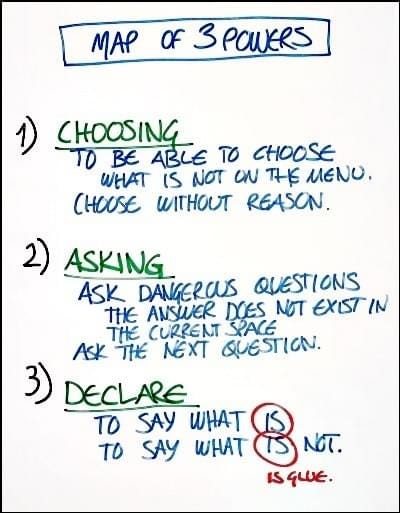
the power to ask dangerous questions, the answers to which may only be findable if you leave the comfortable space you’re in
the power to declare what is so (it is a horrible rainy day; it is just the kind of day I need to finish writing this article; it is a perfect day)
and finally, the power to choose, not just from the choices that lie before you, but also from choices that you did not know about, or that others did not tell you about. You can choose off the menu entirely. That means, for example, you can choose beyond just following or not following an order. You can choose to take a stand for a culture where the order would not be necessary. You can choose that there are no orders, only proposals. You can choose “octopus-kerflooey!”. You can choose anything at all, but importantly, in order for this to be your power, your choice must be made for no reason at all.
I recently watched The Greatest Showman where the main character, P.T. Barnum (of Barnum and Bailey Circus fame) is utterly unaware that he has no choice in what he does. His every action is driven by the compulsive need to prove himself better than his humble beginnings. When his wife presses him about this, he turns to pinning the origin of his need on his daughters. All of my hunger for a better, more opulent life, is for them so no one will ever look down on them. It is a good reason. It might even be partially true. And, it gives him no actual power. He makes things move in the world, building a popular circus, and it is not him that is powerful. It is his reason.
It does not matter how authentic the reason is. He could admit “This is all so I can feed my never ending insecurities about growing up poor” and it wouldn’t change the fact that the reason has the power. The reason is the engine and he is the piston. His never ending insecurity manifests through the world through his particular way.
Becoming a Being happens when you choose for no reason. That is because there is no hiding. There is only what you do.
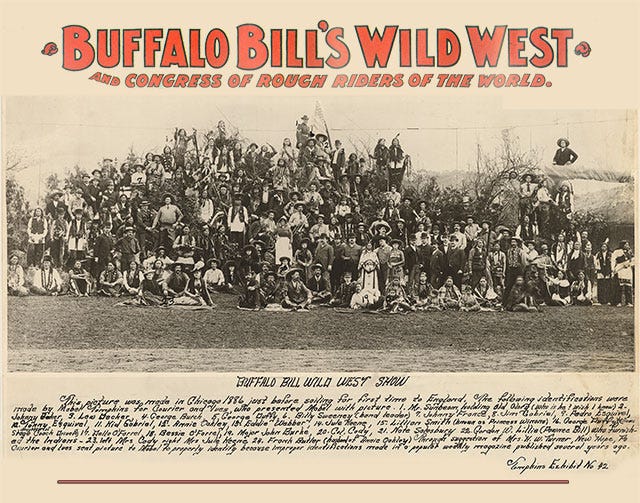
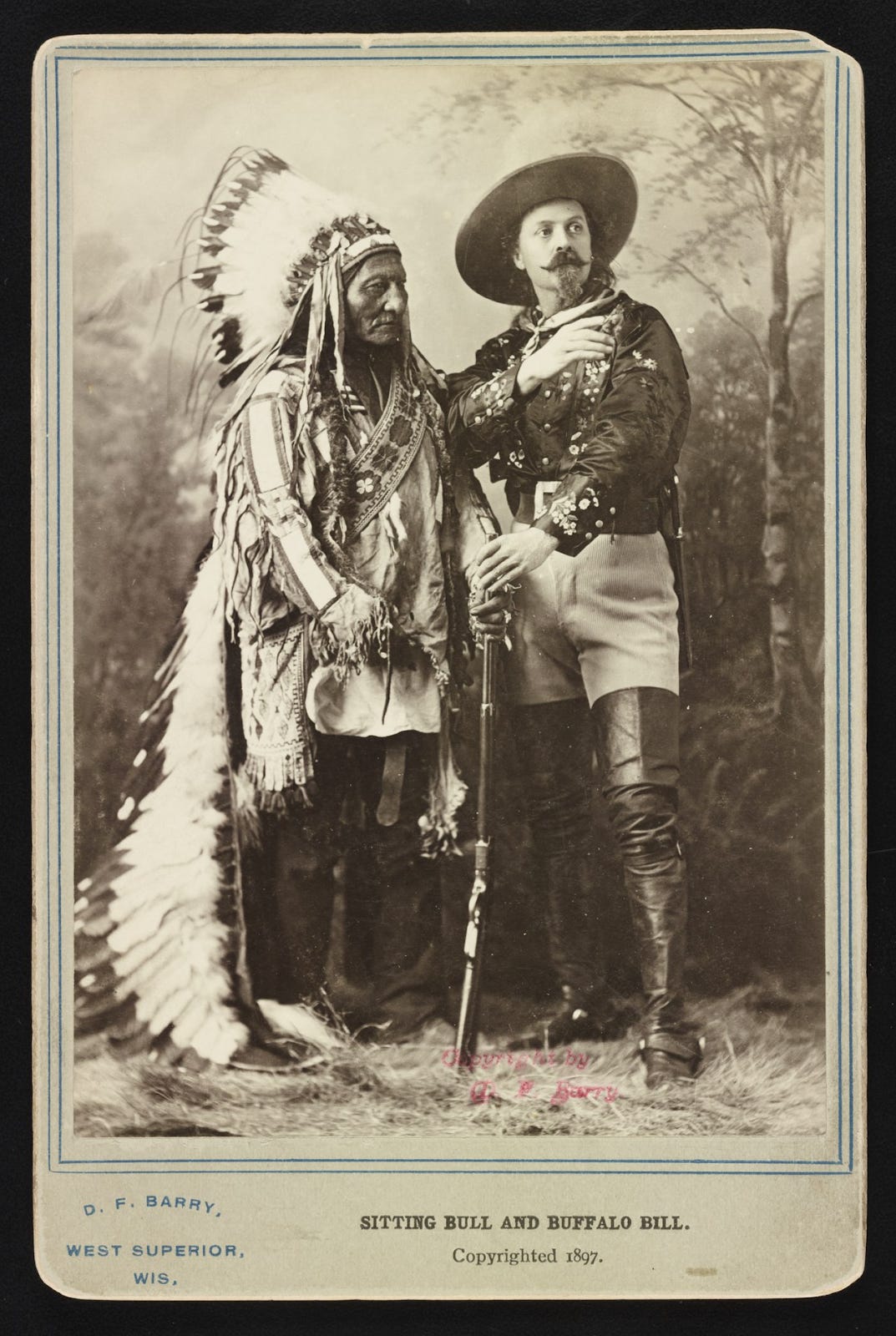
In 1883, a decade or so after P.T. Barnum founded the Barnum and Bailey Circus, another show started sweeping the country. This was Buffalo Bill’s Wild West, started by Buffalo Bill, a former US Army scout who had returned from war with the Native Americans. To join his circus, Buffalo Bill scored a most unlikely collaborator – the man he had fought against nine years prior, the great Lakota leader Sitting Bull.
Sitting Bull joined the show and toured the US cities. He performed in front of large crowds that romanticized him, including in front of President Grant, where he is purported to have cursed in his native tongue “You are thieves and liars. You have taken away our land and made us outcasts.” (No amount of legal justification or reasoning by the government has ever, will ever, or can ever change the unjust consequences that American governments stripped Native Americans of their homes and livelihoods time and time again. On a moral level, or a dignity level, the legal reasoning doesn’t really matter.)
After four months, Sitting Bull left the show and returned home. Soon, the Ghost Dance movement, where Native Americans danced for days to experience a trance like state before collapsing, and which was prophesied would end the invasion of white people if enough people danced, began to spread. The US Army believed Sitting Bull to be instigating this movement, and made plans to arrest him.
An Indian policeman who was part of the arresting party, Red Tomahawk, ended up shooting and killing Sitting Bull.
I was a Sergeant of the Indian Police. Sitting Bull was my friend. I killed him like this…
We opened the door and went in. Sitting Bull was there and he got awake then. He had been singing and dancing and was tired and sleepy, I guess. We told him to go with us. I had hold of his left arm and I had my gun in my hand, too. I told him not to make cry for his people. We would kill him first. We got outside and he made a loud cry as his son came around the corner of the house, and then the hostiles came. His son, Crow Foot, came and was killed right away. He went down these tracks and died. (Pointed to the trail depicted on the map). I shot Sitting Bull in the left side. He fell with his face down. I shot him again in the back of the neck then. He was dead then…
I was under orders so I killed him. He should not have hollered.
It is terrifying to know there are people who operate with that little agency. I was under orders so I killed him. Red Tomahawk cannot deal with what he has done because he has not separated himself from his reasons. It is tragic that such a noble man as Sitting Bull died this way, at the hands of a man with no authority, in a space with no responsibility.
Buffalo Bill gestures with his hand. Sitting Bull stands dignified in the center of his own authority, and it seems to me, hand gesture or not, he will move when he moves.
Sitting Bull knew how to move, and he knew how to choose. He did not choose with haste or because he saw only the options in front of him. He choose with purpose. He created his own choices. When his people were fighting the construction of a railroad across their land, Sitting Bull, rather than running or shooting back at the US Army force led by General George Custer,1 walked within shooting range, sat down on the ground, pulled his pipe out, cleaned it, and began smoking.
Sitting Bull left us with this quote:
Inside of me, there are two dogs. One is mean and evil, and the other is good, and they fight each other all the time. When asked which one wins, I answer, “The one I feed the most.”
Who has the power? It is Sitting Bull, not the dogs. It is you, not your reasons.
I leave you with a dare, to experiment with this power by choosing someone in your life whom you have every reason not to love. Write your reasons down. Read them twice. Decide that your authority does not lie on the page or with them or with the past or with whatever they did. That does not mean that you forget the past or pretend what happened did not happen. But it means that you decide that love comes from you. Begin to love them. It does not need to look any way. You will know when you are choosing how your life goes, not your reasons.
A few years later, it was against that same General Custer that Sitting Bull prophesied he would win a great victory. He saw soldiers “falling from the sky like grasshoppers, with their hats falling off.” Acting on this, he then won a complete victory against them at The Battle of the Little Big Horn.↩︎